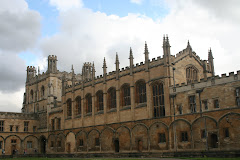
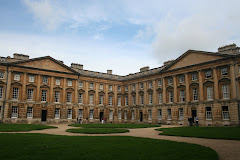
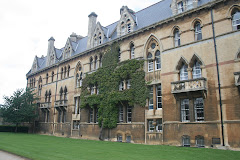
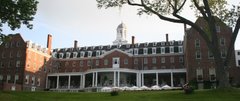
File this under proud papa. As some of you may or may not know, our daughter, Molly, is a staff reporter for her college's daily online and monthly newsmagazine, the DOG Street Journal. DOG stands for Duke of Gloucester Street, Colonial Williamsburg's main pedestrian thoroughfare anchored by the Colonial Capital Building at one end and the college's Sir Christopher Wren Building at the other.
Molly's story received top billing today and this month. I've linked it to my blog. Enjoy.
That's it for the moment. Peace.
Friday, August 31, 2007


Sunday, August 26, 2007
Thoughts on McLaren's The Secret Message of Jesus
I've been in Winchester this week. I've been reading in the area of christology. One particular book held my attention moreso than others, Brian McLaren's The Secret Message of Jesus. The book is as much apology as it is christology. What follows are some of my notes on his book with an occasional observation on my part. If you do not know who McLaren is, I've linked his website to my blog [See "Links worth visitng" below].
McLaren penned his book in 2006 to better understand Jesus and his message. He had become disillusioned by persons who had become convinced beyond a shadow of a doubt that they had figured both Jesus and his message out and, in McLaren's words, had "reduced [Jesus and his message] to their own kind of mathematics. It's these three concepts or those four steps or this simple five part formula, no more sophisticated than an elementary equation."
For McLaren, the church's conventional versions of Jesus have failed to do him justice. Conventional versions fail to see Jesus in his native wildness and original vigor. According to McLaren, Jesus and his message are better than anything we have heard or understood or figured out so far.
Early on in the book McLaren observes that "the portrait of Jesus I found in the New Testament didn't fit with the image of Christianity projected by religious institutions, charismatic televangelists, religious spokespeople in the media -- and sometimes my own preaching." So, he suggests a reappraisal.
McLaren's reappraisal follows familiar lines. He looks at the political and religious climate of Jesus' day. He pushes himself and his readers to fully understand the "interpretive grid" used when reading scripture. We all have one. Our grids help us to see some things all too clearly while blinding us to other things altogether. The zealots wanted Jesus to be a zealot who advocated rebellion and revolution as they did. The Sadduccees wanted Jesus to be a Sadduccee who advocated a go along to get along approach when it came to relating to the Roman occupiers. The Pharisees wanted Jesus to be a Pharisee who advocated an external religious purity and rigor. And so on. The story is familiar. Jesus is cast as one of us.
Jesus resists. We cannot change him. Rather, he invites us to change, which is what repentance is all about.
McLaren makes a lot of the fact that Jesus preferred to get his message across in parables. For McLaren, "parables entice their hearers into new territory . . . [and we] can respond with arrogant and impatient anger (I have no idea what he's saying. This is a waste of time!), which makes you walk away. Or [we] can respond with eager and curious humility (I can't let this go. I must know more!) . . . [P]arables have a capactiy that goes beyond informing their hearers, parables also have the power to help transform them into interactive, interdependent, humble, inquisitive, and persistent people."
Parables invite their hearers/readers to reconsider their world and consider a new one, to admit that what is known may be incomplete or wrong, to give life a second and third and fourth thought, to think. As much as we may want fast, painless, effortless information instead of slow, energetic, engaging transformation, that's not Jesus' way or message. McLaren writes, Jesus' message comes "not as a simple formula or list of information and not as angry ultimatum, but instead as a secret hidden in a parable, like a treasure hidden in a field, like a seed hidden in soil, like yeast hidden in dough."
McLaren draws on the writings of a lot of my heroes -- C.S. Lewis, N.T. Wright, Walter Wink, Walter Brueggemann. If I am not mistaken, Rich's Faith Stretchers book study has either read McLaren's book or are slated to do so this year. A very wise choice. There is a lot here to absorb and utilize.
McLaren, in the book's afterword, includes the poem by Archbishop Oscar Romero of El Salvador, "A Future Not Your Own." It's a poem well suited to sabbaticals and to sabbatical blogs.
It helps, now and then, to step back
and take the long view.
The kingdom is not only beyond our efforts,
it is beyond our vision.
We accomplish in our lifetime only a tiny fraction of
the magnificent enterprise that is God's work.
Nothing we do is complete,
which is another way of saying
that the kingdom always lies beyond us.
No statement says all that could be said.
No prayer fully expresses our faith.
No confessions brings perfection . . .
No set of goals and objectives includes everything.
This is what we are about:
We plant seeds that one day will grow.
We water seeds already planted,
knowing that they hold future promise.
We lay foundations that will need further development.
We provide yeast that produces effects beyond our capabilities.
We cannot do everything
and there is a sense of liberation in realizing that.
This enables us to do something,
and to do it very well.
It may be incomplete, but it is a beginning, a step along the way,
an opportunity for God's grace to enter and do the rest.
We may never see the end results . . .
We are prophets of a future not our own.
That's it for the moment. Peace.
Tuesday, August 21, 2007
Boston, Part III
I'll save the baseball non-enthusiasts game detail, although I enjoyed trying my hand at sports writing. It was an afternoon game, a pitcher's duel. Few hits and fewer runs. The Angels went up early and stayed up. The final score was Angels 3, Sox 1. It was a four game stand, we saw three of them. The teams split. The Angels held their ground against the Mariners. The Sox held theirs against the Yankees. There are 38 games left in the 2007 season. Hold on to your hats.
Two short notes.
Note one: On Saturday we visited the Isabella Stewart Gardner Museum out Huntingdon Avenue. It's around the corner from the Museum of Fine Arts and next door to Simmons College, Northeastern University, and Wentworth Institute of Technology. Given the number of schools in Boston, it appears that everything is next to one.
Gardner was quite the collector. In time, her collection became so large that in 1917 she designed and built a renaissance-era Venetian palace in her beloved Boston to house it. There are more than 2,500 objects - paintings, sculpture, furniture, textiles, drawings, silver, ceramics, illuminated manuscripts, rare books, photographs and letters - from ancient Rome, Medieval Europe, Renaissance Italy, Asia, the Islamic world and 19th-century France and America.
Note two: Woody, Bill, Mary Bruce, and Rossi, my sabbatical advisory panel -- thanks again for the moleskine and the field glasses. Both have been considerable help in my efforts to "see the world with new eyes." They were both used extensively on this leg of my sabbatical. Here is one of the entries I made in the moleskine from the JFK Library. Kennedy was asked how he became a war hero. We all know the PT 109 story. Kennedy replied, "It was involuntary. The Japanese sunk my boat." I am currently rereading "Profiles in Courage" as a result of my visit to the library and museum.
That's it for the moment. Peace.
Additional photographs will be forthcoming.
Sunday, August 19, 2007
Boston, Part II
A blustery summer day. I started the day in shorts -- short pants and short sleeves. After a short walk to the T stop to meet Molly's freshman year roomate from Mount Holyoke, I thought better of my choice of dress. Given the briskness of the wind from the north, long pants and long sleeves seemed the wiser choice. Still, plenty of bright, bright sunshine. By game time, the winds had diminished.
We walked the length and breadth of Newbury Street -- street musicians, artists displaying their work, art galleries, sidewalk cafes. By lunchtime, we settled on Joe's. After lunch, we strolled through the Common Garden, up Beacon Hill and around Louisburg Square. The narrow streets and red bricks and leaf-canopied sidewalks embraced us like an enthusiastic and friendly two-handed handshake.
The evening Sox game could not have been more dramatic. It's 5-2 Angels, bottom of the fifth. Schilling, the Sox's aged starter, has been giving up too many hits and too many runs. However, the bases are now loaded for the Sox. Ortiz is at bat. Ordinarily, he would be walked. Not an option. There's no open base. First pitch, Ortiz, injuries and all -- he will have knee repair surgery in the off season, launches the ball well into the right-field grandstand, at least as far as the lone red chair signifying the distance of Ted Williams' longest ball. Grandslam homerun. Ortiz has done this before, numerous times in fact. Gone is the Angel's lead. It's now 6-5 Sox. Boston goes on to win it 10-5.
Schilling was the starting pitcher and ended up getting the win, not because of his stuff, but because of his team's offense. Our seats were first row, right-centerfield, looking into the bullpen. In addition to watching Schilling warm up, we watched as well the middle relievers and closers warm up -- Timlin, Okajima, and Papelbon. Papelbon's boyish charm and 29 saves on the season electrifies the crowd like nothing else. He picked up save number 30 this night and kept his earned run average fighteningly close to one.
That's it for the moment. Peace.
Saturday, August 18, 2007
Boston
Molly and I got into town late on Thursday evening. Our evening meal was at Maggiano's, across the street from our hotel, the Park Plaza.
Yesterday, we took the T to the JFK Library and Museum on Columbia Point adjacent to the campus of the University of Massachusetts at Boston. I. M. Pei's design is striking. We had lunch in the cafe. Our view out of the very large wall of glass was the Boston skyline to the left and the Boston Harbor with its numerous islands to the right. The sky was a clear blue with the occasional fair weather summer cloud.
In the late afternoon we made our way to Faneuil Hall and Quincy Market for window shopping, people watching, and gelati eating. We avoided the T at rush and walked back to our hotel via the Washington Street pedestrian mall.
The Red Sox v. Angels game at Fenway was a thriller. Beckett, the Sox's starting pitcher, turned in an admirable performance. He left in the seventh inning having allowed only two runs, one of which was unearned off of an error on the shortstop, Lugo. He struck out eight, walked one, and gave up only five hits. It would have been nice if his team could have provided him with some offensive support and some decent relief from the bullpen. The offensive support would come, not so the relief.
Jump to the bottom of the eighth. The score is now 4-2 Angels. A flurry of hits, including back to back doubles by Ortiz and Ramirez, resulted in a score of 5-4 Red Sox. Sadly, the top of the ninth followed with very lively and very big Angel bats, namely Vlad Guerrero's. There is a reason the Angels are on top of the AL West. Guerrero's two RBI double off Sox reliever Eric Gagne put the the final score at 7-5 Angels. The Sox produced two ejections in the bottom of ninth, Manager Terry Francona and First Baseman Youkilis, but no runs. The arguments centered around whether a pitch to Youkilis was a third strike or a foul tip. The first base umpire, to whom the plate umpire appealed, was of the opinion that it was a strike. Francona, Youkilis and the replay on the centerfield jumbotron were of a different opinion altogether, one based in fact rather than fiction I might add.
Molly and I walked the mile and a half down Boyleston back to our hotel.
That's it for the moment. Peace.
Monday, August 13, 2007
Thoughts on Current Reading
I just finished reading Kevin Lawson's book HOW TO THRIVE IN ASSOCIATE STAFF MINISTRY. The presbytery should require the text for any and all associate staff positions. For the most part, Lawson confirmed for me the reasons why, after more than twelve years now, I still sense a profound call to serve God and neighbors in and through First Church.
For starters, there are the work relationships. Among and within the staff and elders, there is a high level of trust, encouragement, affirmation, and loyalty -- fruits of the Spirit all -- as well as feedback and evaluation. We cooperate rather than compete. What I am concerned about, you are concerned about. What you are concerned about, I am concerned about.
The high value that is placed on each and every ministry, rather than only a few, stands out. There is no unimportant work at First Church. Additionally, First Church's commitment to growth and learning for its leadership -- this sabbatical is a case in point -- and its commitment to people over programs contribute to health and vitality. So too does the church's general openness to new ideas and approaches.
I could go on, I guess. However, I don't want you to feel schmoozed. Nor, do I wish to jeopardize your saintly humility. But I do want you to feel affirmed. I cannot begin to describe how affirmed I feel at the moment. Thank God and thank you.
That's it for the moment. Peace.
PS: Molly and I set out for Boston on Thursday. We have tickets for the weekend's three-game Red Sox homestand against the LA Angels at Fenway. The Sox are on top of the American League East. The Angels are on top of the American League West. We may be witnessing a rehearsal of the 2007 American League Championship Series. In addition to baseball, we will be touring the JFK Library in Boston and Edith Wharton's Berkshire Mountain home, The Mount, in western Massachusetts.
Friday, August 10, 2007
Final Remarks on Scotland
Have I traveled to more than just another continent? Another planet perhaps?
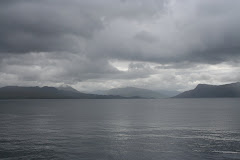
The Western Highlands and the Hebrides have an other-worldy appearance. I had to consult a guidebook or two to better understand what I was looking at. Scotland's rocks display three billion years of geological time. Pretend you are looking at Scotland from a bird's eye view. Hold your left hand out and allow it to superimpose itself over your view of Scotland. Spread your fingers and thumb slightly. Your thumb is England. Each of your four fingers is one of the four faults that define Scotland's geology. Your index finger is the Southern Uplands Fault. Your middle finger is the Highland Boundary Fault. Your ring finger is the Great Glen Fault. Your pinky finger is the Moine Thrust.
Our coach travelled the length of the Great Glen, from Inverness to Fort William. The Great Glen is a glacial rift valley that was created when the landmass split and moved about 400 million years ago. There are four lochs in the glen -- Loch Ness, Loch Och, Loch Lochy, and Loch Linnhe. Our hotel in the glen was at Ballachulish on Loch Linnhe.
We left mainland Scotland, which is an odd remark given that it is a part of the British Isles, at Mallaig and ferried to Skye, the largest of the Hebridean isles. Skye never freezes. Given the fact that the temperatures during our visit in early August never rose above 60 (F), I have my doubts. However, this is in fact where the Gulf Stream winds up after bumping gently against the Irish coast just across the way.
On our journey south to Glasgow, we passed through Glencoe. Our final full day in Scotland was a day of contrasts. We went from Scotland at its most rural to Scotland at its most urban. Glencoe's scenery is mesmerizing -- craggy peaks and moss covered ridges spewing rivulets of water. Glencoe's history is appalling. It is the place where the name Campbell became synonymous with betrayal, murder, and treachery. In 1692, Clan Macdonald, suspected of Jacobite sympathies, was late in registering its oath of submission to King William III. Clan Campbell was enlisted by the throne to punish the Macdonalds for failing to submit by the January 1, 1692 deadline. The Campbells arrived in Glencoe amidst a brutal blizzard. The Macdonalds took their fellow Scotsmen, Campbells, in and provided them with food and lodging until the winter broke. At dawn on 13 February, the Campbells repaid their hosts with death and destruction. Thirty-eight Macdonalds were killed. Countless others fled and died of exposure.
That's it for the moment. Peace.
Subscribe to:
Posts (Atom)